Finding the right algorithmic trading platform in the USA is critical for success. We compare the top 7 platforms including commission structures, API quality, supported assets, and ease of use to help you choose the best fit for your trading goals.
Discover advanced trading automation at jayadevrana.com
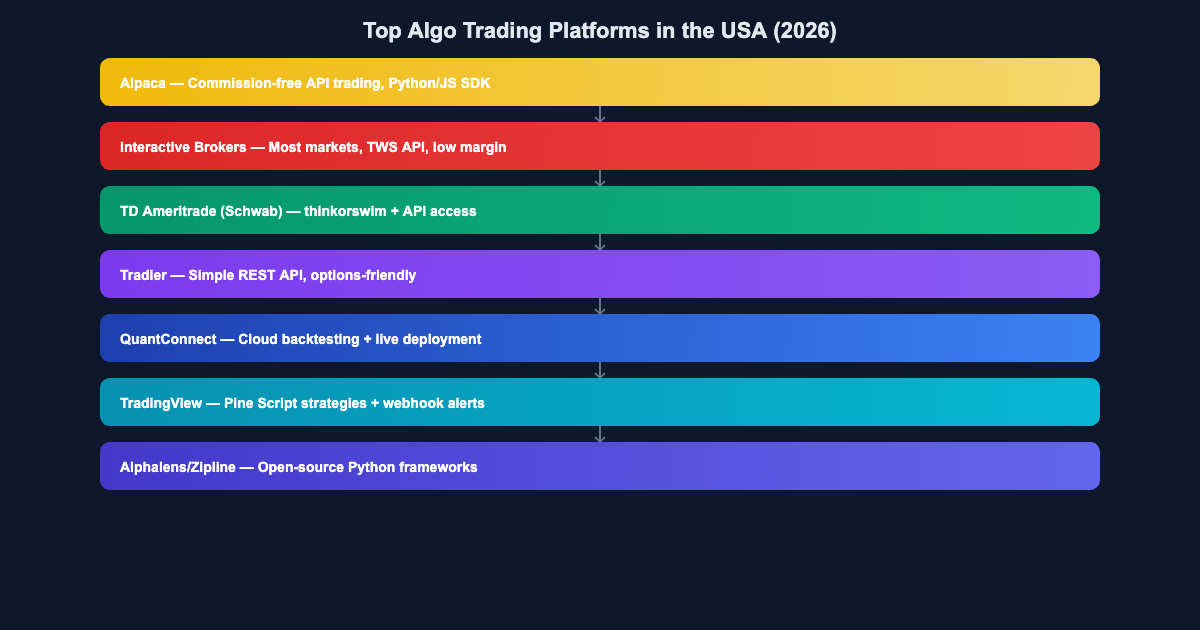
1. Alpaca: Best for Retail Algo Traders
Commission: Zero commissions on stocks and ETFs
Minimum Balance: $100 (no PDT requirement waiver available)
API Quality: REST and WebSocket APIs, excellent documentation, Python-friendly
Supported Assets: Stocks, ETFs, options (limited)
Paper Trading: Yes, full paper trading available
Alpaca is the best entry point for retail traders wanting to automate strategies. The zero-commission structure and low minimum balance ($100) make it accessible. Their REST API is intuitive, and the Python SDK is among the best-documented in the industry. The main limitation: no PDT rule waiver, so day traders need a $25,000 minimum balance.
2. Interactive Brokers: Most Comprehensive
Commission: $0.70 per equity trade (min/max varies by product)
Minimum Balance: $2,000 (with margin approval)
API Quality: TWS API, Client Portal API, FlexWeb queries
Supported Assets: Stocks, options, futures, forex, bonds, crypto
Paper Trading: Yes, paper trading account available
Interactive Brokers offers the most comprehensive API ecosystem and asset coverage. The TWS (Trader Workstation) API is more complex but allows execution across all asset classes. The lower minimum balance ($2,000) and deep liquidity make it ideal for serious algo traders. Commission per trade is minimal compared to traditional brokers.
3. TD Ameritrade / Schwab: Integration and Stability
Commission: $0 on equities, $0.65 per options contract
Minimum Balance: $0 (but PDT rule applies to accounts under $25,000)
API Quality: thinkorswim API, discontinued public API (transition to Schwab)
Supported Assets: Stocks, options, futures, forex
Paper Trading: Yes, through thinkorswim platform
TD Ameritrade (now Schwab) is stable and regulated. The thinkorswim platform is powerful, and integration with Schwab’s infrastructure is seamless. However, their public API deprecation means new developers should prioritize other platforms. Existing TD clients benefit from stability and excellent execution.
4. QuantConnect: Cloud-Based Backtesting Engine
Commission: Free tier available; paid tier $199-$2,000/month
Minimum Balance: Depends on broker integration ($100+ with Alpaca)
API Quality: LEAN engine, broker integrations (Interactive Brokers, Alpaca)
Supported Assets: Stocks, crypto, forex (depends on broker)
Paper Trading: Yes, paper trading supported
QuantConnect excels in backtesting and live trading through broker integrations. The LEAN engine allows complex strategy logic with minimal code. Best for quant-focused traders who want professional-grade backtesting before deploying real capital.
5. Tradier: Developer-Friendly API
Commission: $0-$4 per equity trade (varies by plan)
Minimum Balance: $0 (but PDT rule applies)
API Quality: REST API, excellent webhooks, sandbox environment
Supported Assets: Stocks, options, futures
Paper Trading: Yes, sandbox environment available
Tradier’s REST API is clean and well-documented, with robust webhook support for alert-based trading. The sandbox environment lets you test strategies risk-free. Lower commission structure than IB, making it competitive for active traders.
6. TradingView: Charts + Alerts + Webhooks
Commission: Not a broker; integrates with Alpaca, Interactive Brokers, others
Minimum Balance: Depends on broker
API Quality: Pine Script + Webhooks
Supported Assets: All (depends on broker)
Paper Trading: Yes, paper trading via connected broker
TradingView is not a broker but a charting platform that integrates with multiple brokers. Its Pine Script language is beginner-friendly, and webhook-based alerts automate order execution. Perfect for traders wanting to use TradingView charts for signal generation.
7. Zipline: Open-Source Backtesting
Commission: Free and open-source
Minimum Balance: Not applicable (local backtesting)
API Quality: Python library, research-focused
Supported Assets: Stocks (primarily US equities)
Paper Trading: Limited; local backtesting only
Zipline is best for researchers and traders who want free backtesting without broker integration. The Python library is powerful but requires coding knowledge. Not ideal for live trading but excellent for strategy development and validation.
Comparison Table
| Platform | Commission | Min Balance | Best For |
|---|---|---|---|
| Alpaca | $0 | $100 | Retail traders, zero-commission |
| Interactive Brokers | ~$0.70 | $2,000 | Professional traders, all assets |
| TD Ameritrade | $0 | $0 (PDT) | Existing clients, stability |
| QuantConnect | Free-$2k/mo | $100+ | Quant backtesting focus |
| Tradier | $0-$4 | $0 | API-first developers |
| TradingView | Chart fee | Broker-dependent | Alert-based automation |
| Zipline | Free | N/A | Strategy research |
How to Choose the Right Platform
For beginners: Start with Alpaca (zero commissions, no PDT) or Tradier (simple API).
For professionals: Interactive Brokers (comprehensive) or QuantConnect (backtesting).
For chart-based trading: TradingView + webhook bridge to your broker.
For research: Zipline (local) + QuantConnect (cloud).
Learn how to automate trades with TradingView and Alpaca to get started immediately.
Ready to launch your algo trading system? We can help you set up automated strategies on your chosen platform in minutes. Connect with us for a free consultation.
Message us on WhatsApp to get started.
About the Author